How to flash your ECU (Windows)
Flashing writes new software to your car's engine or gearbox controller — it's how a tune, an update or a return to stock gets onto the car. The app checks the critical conditions before it starts and guides you through each step; your part is simple: stable power, a stable connection, and a few minutes of patience. The Windows app flashes over a wired USB connection, over Bluetooth, or over DoIP on supported cars.
Before you flash
- Connect the car to a battery charger. A voltage drop mid-flash is the most common cause of failures.
- Gearbox in Park (or neutral with the handbrake on).
- Hood open, ignition on, engine off.
- Keep the laptop on mains power and stop it from sleeping — the app asks you to confirm the battery is above 20%, and a flash must not be interrupted by the computer going to sleep.
- Stable internet: the file and protocol settings are downloaded from the portal during the flash.
- Don't unplug the dongle, disable Bluetooth, quit the app, or do anything else on the computer until the flash finishes.
- The file must already be available for this car's VIN in your account.
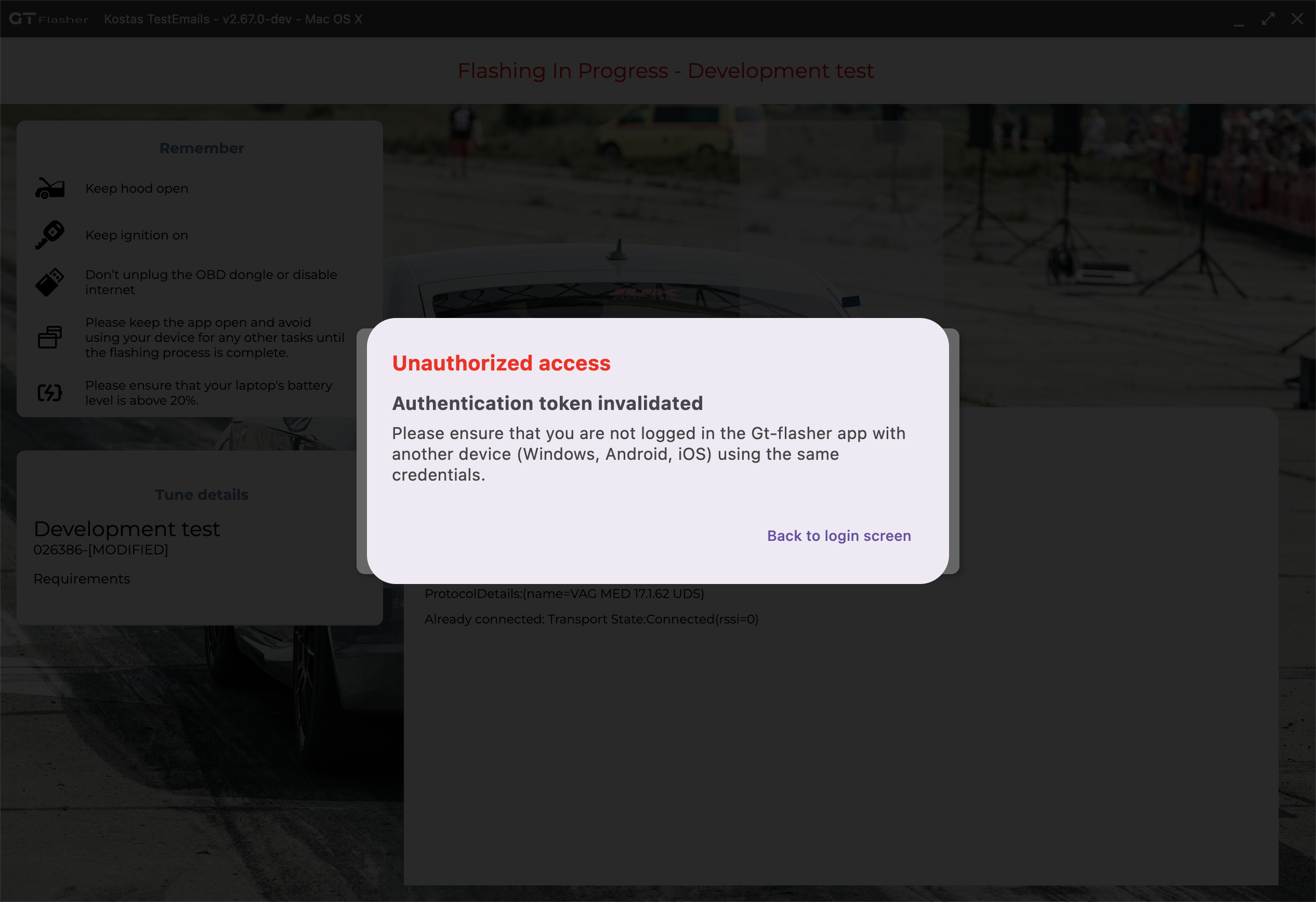
- Sign in on only one device. If you are also logged in on the phone or another computer with the same account, the flash is interrupted with an Unauthorized access message (see Troubleshooting).
1. Open the Flashing screen
Connect and identify your car first (see the logging guide for the connect and identification steps — the flow is the same). Then click Flashing in the left navigation rail. Without an identified vehicle the screen prompts you to identify first.
Note: if the app cannot find a specific protocol it may fall back to a Generic ECU / Generic ECU Extended / Generic TCU entry in the protocol list. These generic protocols allow identification, DTC reading and logging, but do not include flashing definitions or security unlocks — flashing will not be offered for a generic protocol.
2. Pick a file
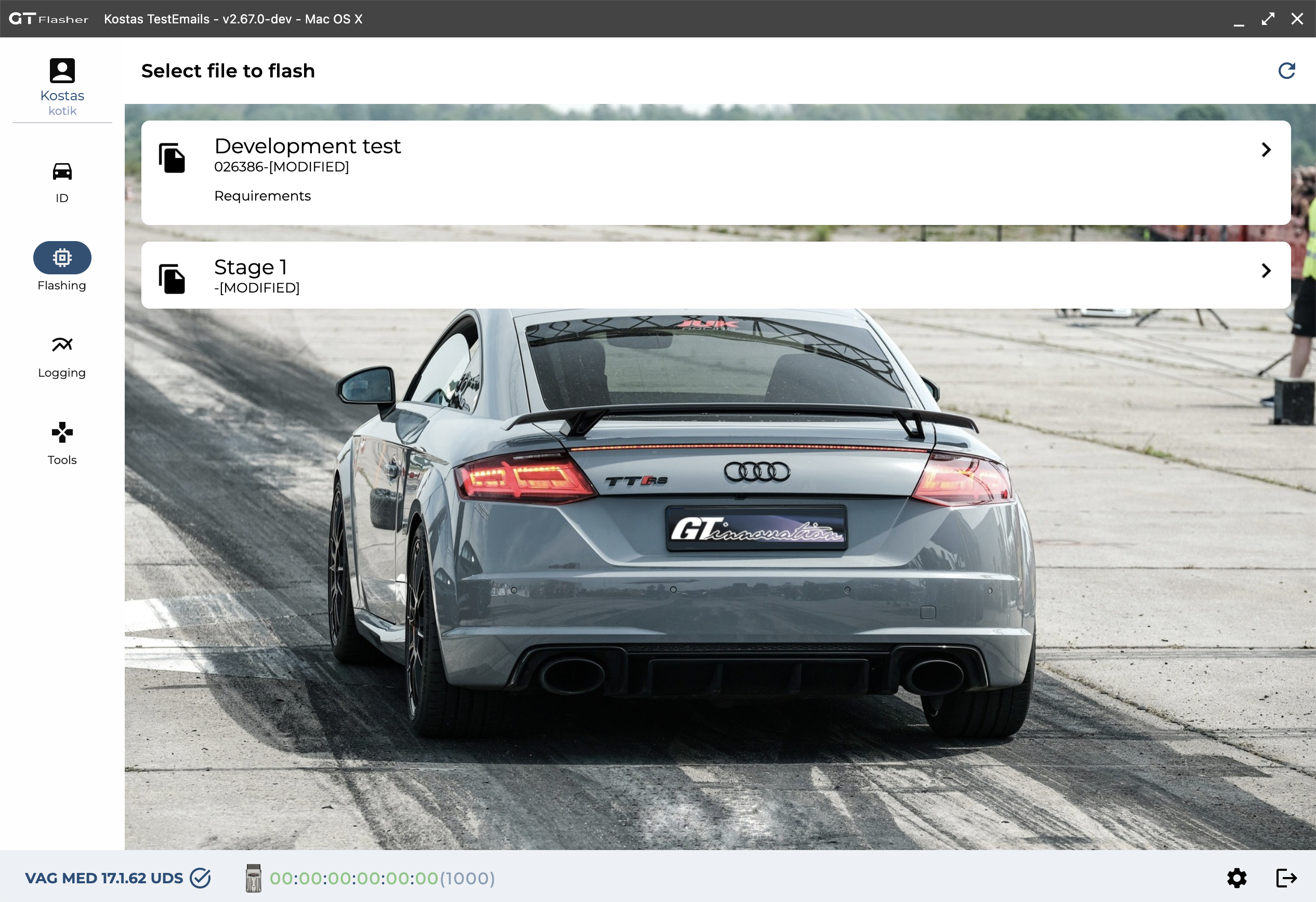
Select file to flash lists the files available for your car. Each row
shows the description, the file number and its type in brackets — e.g.
026386-[MODIFIED] for a tuned file or -[ORIGINAL] for stock — with a
short requirement note underneath. Use the refresh icon (top right) if a
newly purchased file hasn't appeared yet. To activate or buy more files,
use your account on the web portal in a browser.
Personalizing a tune
If the file supports it, a Tuning available screen appears first: Flash without changes proceeds as-is, Adjust calibration lets you tweak the listed parameters (the first time, you must accept the User Modification Liability Disclaimer). On the preview screen, review your changes and click Finalize — incorrect values can damage hardware, and you proceed at your own risk.
See Adjusted calibration for the full step-by-step.
3. The pre-flash checklist
On Check all options to start, turn on all five switches:
- Keep hood open
- Keep ignition on
- Don't unplug the OBD dongle or disable internet
- Keep the app open and avoid using the computer for anything else until flashing completes
- Make sure the laptop's battery level is above 20%
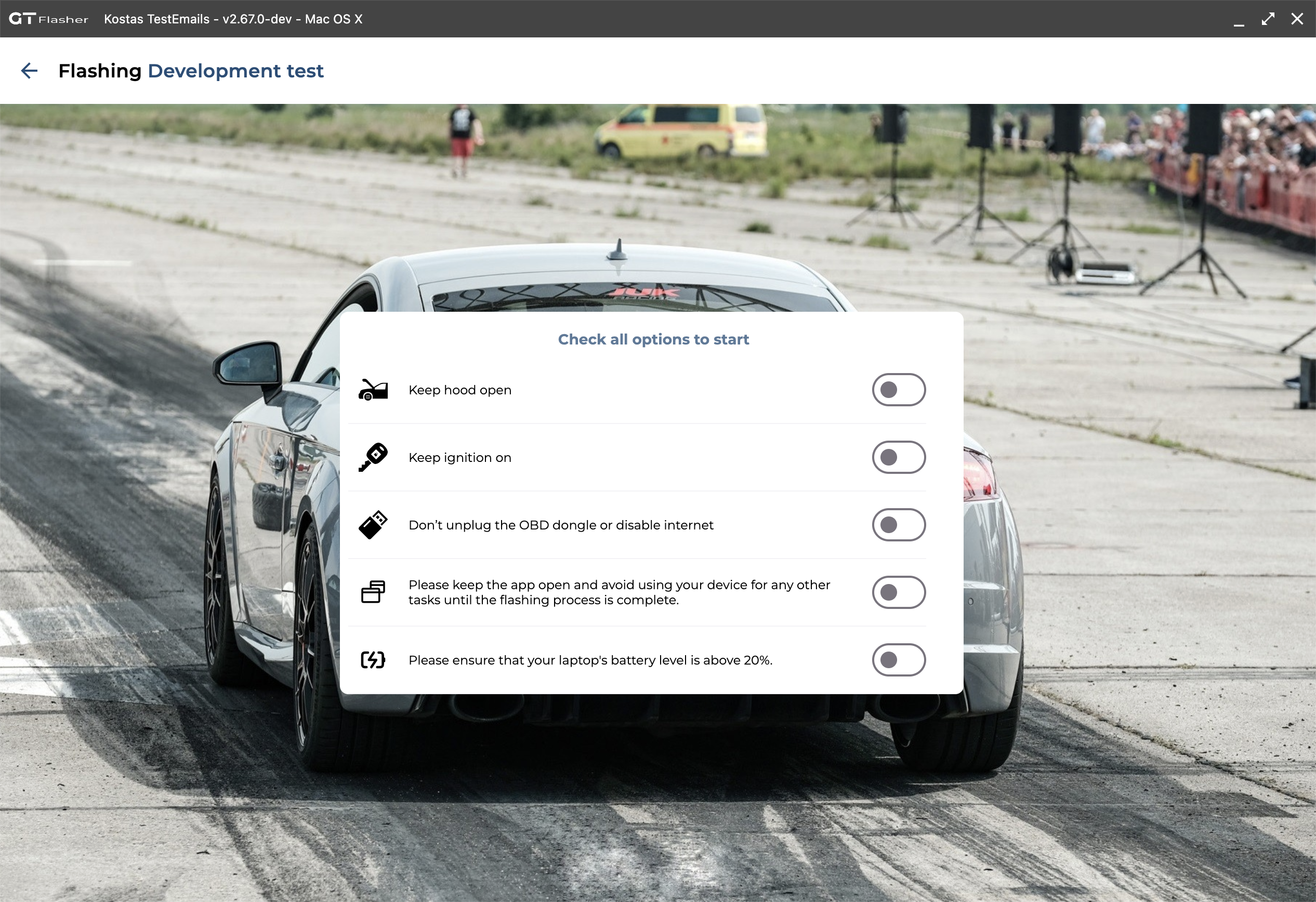
When all five are on, the Tune details card appears with "All set, now you are ready to start!" — click Start flashing.
4. During the flash
The screen changes to Flashing In Progress. A Remember panel on the left repeats the five rules, the Tune details card shows which file is being written, and a progress ring shows the percentage. The status feed on the right reports each step live — preparing and downloading the file, correcting checksums, granting security access, then erasing, writing and verifying each block. Leave the computer alone while this runs.
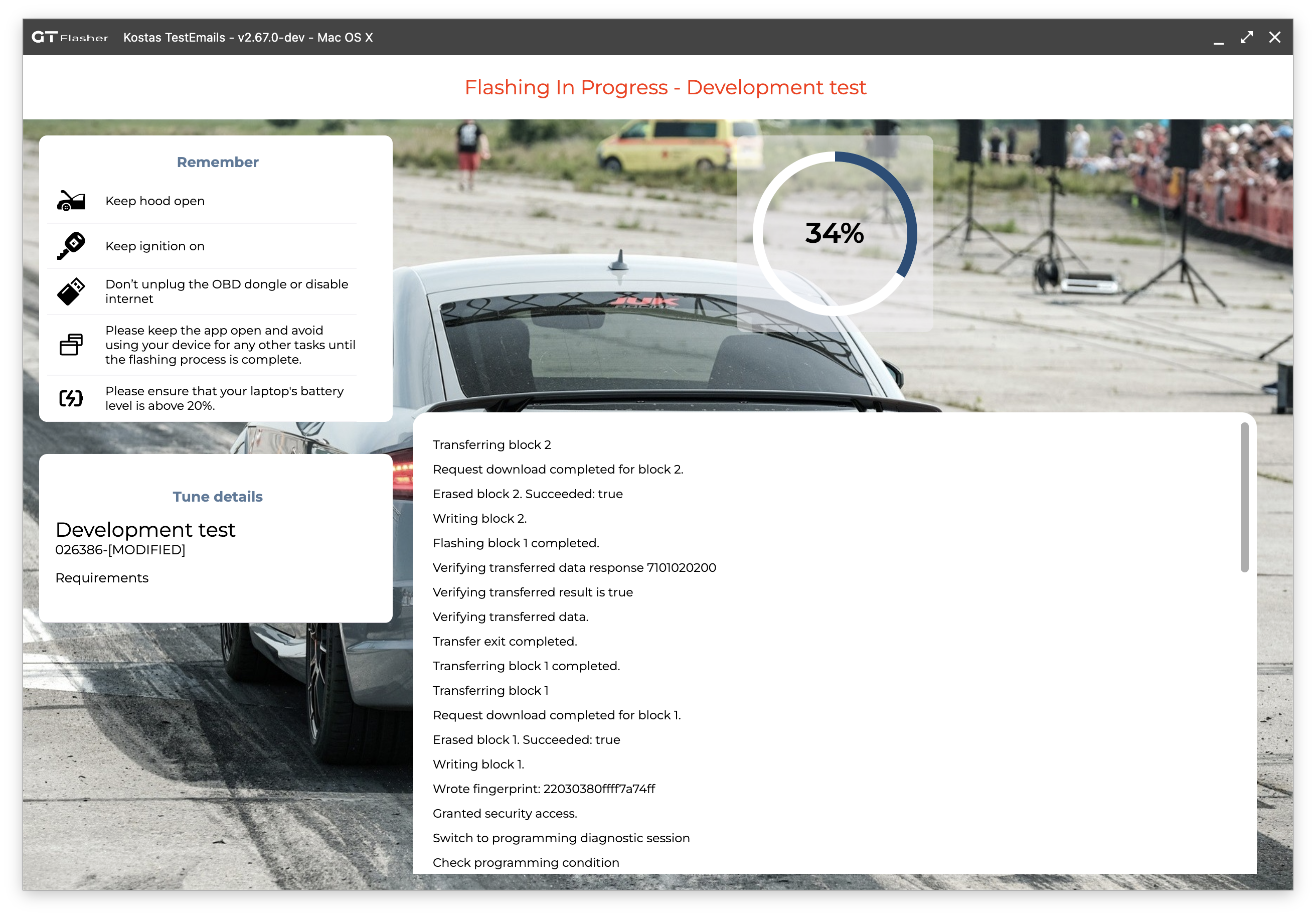
On MG1-family ECUs the flash pauses once with ⚠️ Action required ⚠️: switch the ignition off, wait 10 seconds, switch it back on without starting the engine, then continue (the button unlocks after a 10-second countdown). DoIP flashing is only offered on MG1-family cars.
On Med17 twin-ECU cars the app flashes both ECUs in one run.
5. After the flash
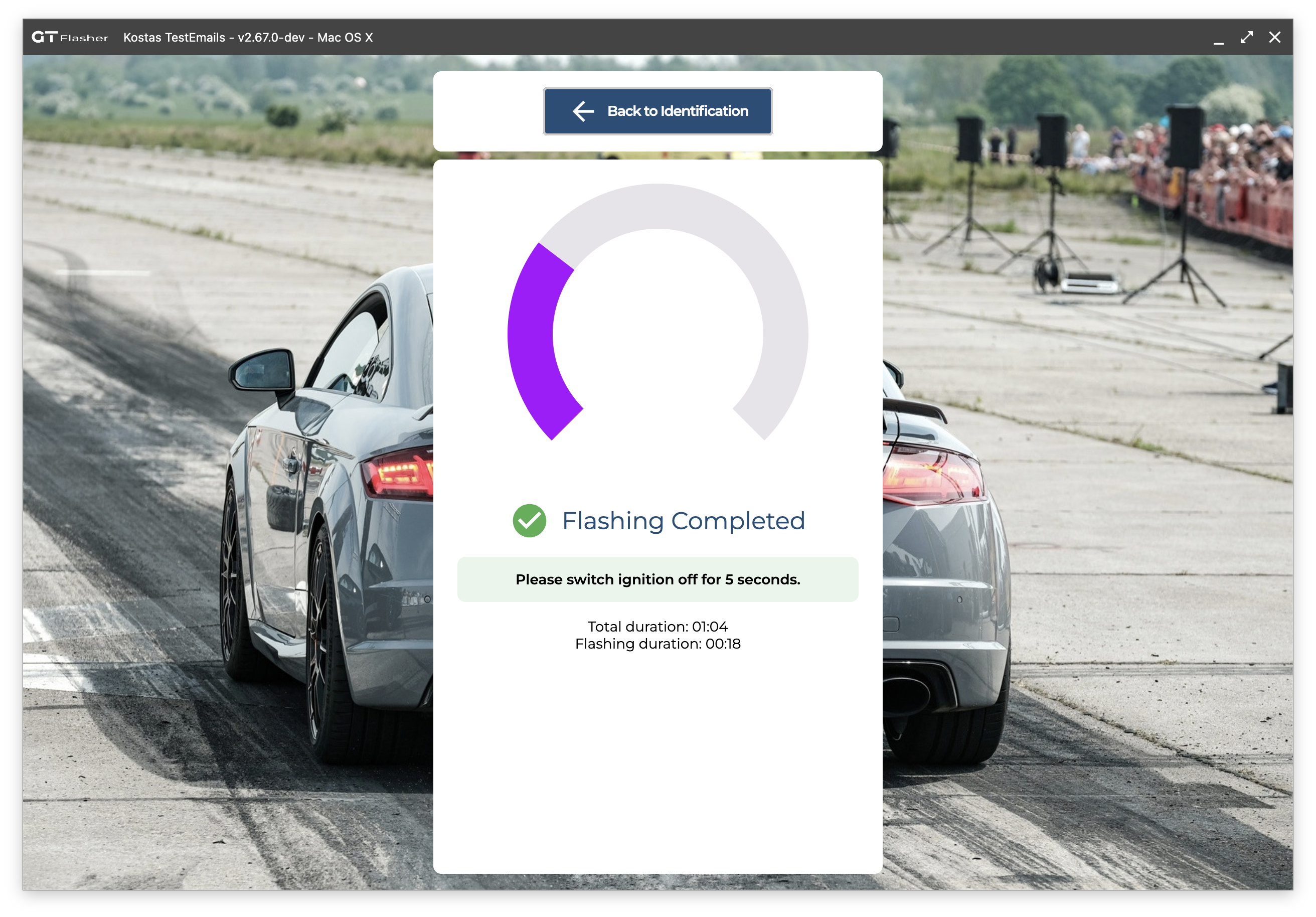
Flashing Completed shows a green check and the total and flashing durations — switch the ignition off for 5 seconds, then you're done. Back to Identification returns to the start.
Right after a flash, give the ECU a few gentle pulls to adapt before judging the tune or recording support logs.
If something goes wrong
A failed flash is almost always recoverable: the error log reaches support automatically and you can simply retry. Every failure shows a dialog with Retry (restarts the whole flash) and Cancel flashing — follow the dialog's instructions first:
| Dialog | What it means / what to do |
|---|---|
| Unauthorized access — "Authentication token invalidated" | You're signed in on another device (Windows, Android, iOS) with the same account. Log out there, click Back to login screen, sign in again, then redo the flash. |
| Operation failed (battery) | Laptop battery under 20% — plug in the charger and retry. |
| Programming Preconditions Not Met | The car refused programming — the message says why (ignition off, immobilizer, temperature, engine running). Fix that and retry. |
| Connection to Your Car is Unstable | Keep the ignition on, check the USB/Bluetooth link to the dongle, and Retry. |
| Temporary Sync Issue | Aftermarket CAN devices interfere — remove or deactivate them and retry. |
| Unstable Network Detected | The computer's internet dropped — restore it and retry. |
| "RMBA unlock is required to flash this file..." | Flash the unlock patch first, then identify the ECU again. |
If a flash failed and the car won't start, don't keep cycling the ignition — leave the ignition on, keep the charger connected, and retry the flash; if retries keep failing, contact support with the car still on the charger.
Going back to stock
There is no separate restore button: flash the Original file from the same list, with the same precautions. If no original is listed, contact support.